When my family and I traveled to Japan this past October, I expected beauty, culture, and a little nostalgia. What I did not expect was a consulting lesson from Nintendo®.
I grew up in the 80s, so Mario is beloved in this house. Even though I could never make it past 4 levels in the game. I remember the excitement of putting that cartridge in the console (don't forget to blow the dust out!) for the first time. The feeling of the revolutionary "power pad" under my feet as my sister and I played Track and Field. The long jump was our favorite.
So when we won the lottery ticket to visit the Nintendo History Museum in Kyoto, and trust me, these tickets are nearly impossible to get, it felt like stepping into a piece of my childhood.
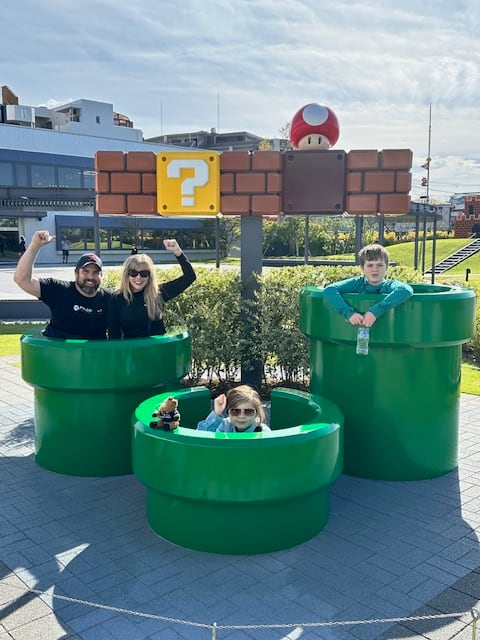
The family playing the super-sized, Super Mario® game at the Nintendo History Museum in Japan.
Walking through the Nintendo History Museum, a company-owned and operated by Nintendo Co., Ltd., you see an extraordinary legacy of reinvention. They began as a small playing-card manufacturer in 1889. No consoles. No franchises. No Mario. Just handcrafted cards. Over the next century, they pivoted repeatedly, shifting from cards to toys, to arcade systems, to home consoles, then to handhelds, then to immersive, story-driven worlds.
None of those pivots was born from failure. They were derived from observation, iteration, and a willingness to evolve before the market forced their hand.
That pattern hit me hard because that same story is woven into my personal journey and into the rebirth of The Jule Group®.
There's no shame in reinvention. In fact, it's survival.
For years, my business represented everything I had been in previous seasons. Talent acquisition strategy. Management consulting. Hiring workflows. Technology assessments and selections. Implementations. Branding. Recruiting. I did great work. I'm proud of what I built; however, as the recruiting market shifted dramatically with the adoption of AI and changes in the employment market, I found myself less passionate about staying on the cutting edge of that particular industry.
I had already begun to niche down, focusing on the nonprofit sector where I could make the greatest impact. I was also wrapping up my final quarter of my Master's degree in Organizational Leadership. It felt like time to expand my experience in a new direction.
So when the Executive Director opportunity came, I ecstatically said yes, and I was off to the races!
It started great, I was getting to know the team, volunteers, BOD, donors, and community. When I say, I loved this job with every fiber of my being, I mean it. I was there for all of the right reasons and in a position to make a huge impact on the community we served, but within months, I navigated challenges most EDs don't see compressed into such a short timeframe. The unexpected death of a team member, two forced reorganizations, rapid succession planning, major fundraising events to take over, critical vendor concerns, new hardware and software rollouts, upskilling the team, annual budget season, and recruiting new board members. These things are part of the job, yes. But they came like a tsunami wave, one after another, without pause.
I rose to each challenge. I showed up. I led through it.
Until one week, I didn't.
The panic attacks started coming like aftershocks after the earth has moved beneath your feet. At first, I couldn't tell if it was stress, anxiety, or something more serious. As a wife, mother, and the daughter of a woman who had her first heart attack at age 40, I knew I couldn't ignore what my body was telling me.
The final realization came while suddenly lying under bright overhead lights, hooked up to wires during an EKG scan with my husband rushing into the room. The look on his face revealed a fear I had not seen before.
The doctor was direct: "You're lucky this was only a panic attack. But this pace, this job? It needs to go, or you'll be back under much more serious conditions."
That moment, lying there, knowing I had a choice, is the reason I'm here now.
I'm grateful for that season. It showed me what nonprofit leaders carry in ways no consulting engagement ever could. It gave me empathy that can only come from being in the seat. But it also showed me where I could make the biggest difference: not by enduring the chaos myself, but by building the systems that prevent others from having to.
That moment illuminated the tension I'd been carrying. Nintendo® has never apologized for outgrowing its previous identity. It didn't feel the need to explain why it no longer made playing cards or why it shifted from toys to tech. It simply watched the world, saw where it could contribute, and evolved.
There's no shame in that. There's only wisdom.
And I needed to hear that, because somewhere along the way I'd convinced myself that leaving the ED role meant I'd failed. That stepping away was proof I wasn't strong enough. If I were truly good at this, I would have been able to sustain that pace.
But that's not how transformation works. Reinvention isn't instability. It's survival. It's paying attention when your body and your work are screaming that something has to change.
That quiet confidence unlocked something in me.
This iteration feels the most aligned I've ever been
I've run The Jule Group® since 2018. I've tried on different versions of what it could be. Some felt close. Some felt forced. But this, what The Jule Group® is becoming now, this is the first time I've felt like the work and the woman are finally, fully aligned.
Architecting human-first systems for nonprofits isn't a departure from where I began. It's what I was always moving toward, even when I couldn't see it yet. Every consulting engagement, every leadership challenge, every moment in the ED seat was quietly building toward this.
This is the work I was made to do. Not because it's easy, but because I've lived it. I've felt what it's like to move at breakneck speed through change. To navigate crisis after crisis. To watch your body send warning signals that you can't ignore.
I know what nonprofit leaders carry on their shoulders because I've carried it too. And that experience (the one that nearly broke me) has become the very thing that makes this work possible.
For the first time in years, I'm not second-guessing myself. I'm not wondering if I should have stayed. I'm not carrying the weight of a pace that was unsustainable.
I'm building something that feels true.
And that clarity, that alignment, that sense of rightness didn't come from having it all figured out from the beginning. It came from being willing to fall apart and rebuild. It came from burnout, teaching me what matters. It came from standing in a museum in Kyoto, Japan, looking at 135 years of evolution, and realizing that transformation isn't the exception. It's the path.
This moment is being met at the perfect time
There's a part of me that wishes I'd recognized the warning signs sooner. That I could have learned these lessons without lying under those bright lights, wired to an EKG machine.
But I also know that's not how this works.
The nonprofits I serve need someone who's been in the seat. Who's felt the weight of leading through impossible circumstances. Who understands that "just work harder" isn't a strategy. It's a prescription for burnout.
They don't need someone who theorizes about organizational health. They need someone who's experienced what happens when systems fail and humans reach their breaking point. Someone who's committed to building something better.
And I wouldn't be that person without everything that came before.
So maybe this moment isn't early or late. Maybe it's exactly on time.
The world is shifting fast. Funders are changing priorities. Boards are rotating. Technology is moving faster than most nonprofits can adopt it. The organizations doing the most urgent, human work are the ones with the least margin for error.
They need systems that give them their time back. They need partners who understand that transformation isn't about doing more...it's about doing differently. They need someone who's been where they are and made it to the other side.
That's what this new chapter is about. That's what The Jule Group® has become.
All of that shaped the work I am called to do now: architecting human-first systems that give nonprofits their time back. Helping them evaluate what is no longer serving them. Building systems that honor the people doing the work. Adopting responsible AI that reduces burdens rather than adding more. Moving forward with clarity instead of chaos.
This isn't a departure from where The Jule Group® began. It's the next evolution.
And it required me to admit that staying the same and continuing to do work that looked good on paper but felt hollow in practice, would have been the riskier choice.
Change is a strategy, not a reaction
The nonprofits I support rarely have the luxury to coast. Their work is too urgent, too human. Their environment changes constantly. To survive, they must adapt.
And here is the truth: adaptation is a muscle. You build it through practice, not panic.
Nintendo® survived 135 years because they practiced change. Not once. Repeatedly. They held identity loosely and vision tightly.
That is the work I help nonprofits do now. Not burn everything down, but see clearly what's ready to evolve. To practice transformation before crisis forces it.
Reinvention is not the opposite of stability. It is the path to it.
Visiting the museum in Kyoto reminded me that evolution is not proof you were on the wrong path, but evidence that you are learning. You are paying attention. You are willing to recognize when something needs to change.
Or, in my case, willing to listen when my body made it impossible to ignore.
That is where The Jule Group® stands today.
We are not who we once were. And I am not who I was when I started this work in 2018. I've lived enough seasons to know this: the intersection of joy and genius emerges through motion. Through listening. Through willingness to transform. Through moments that test you and choices that redirect you. Through recognizing when your body is telling you something important.
And through the courage to say, "This pace isn't sustainable. And choosing differently isn't failure. It's wisdom."
I'm standing at the edge of this new chapter with clarity I didn't have before. With the empathy and compassion of someone who's been in the ED seat and the commitment to build systems that prevent others from reaching that breaking point. With hard-won experience and renewed purpose.
This is the most aligned, excited, and alive I've felt about my work in years.
And if you're standing at your own pivot point, if you're feeling the tension between the pace you're maintaining and the pace that's sustainable, I want you to know: there's no shame in recognizing that. There's only wisdom. There's only the courage to choose differently.
Tricia Smith, Founder of The Jule Group®
If your organization is standing at its own pivot point…
You need someone who can help you see what is ready to evolve. Someone who's been where you are. Someone who knows that transformation isn't about doing more. It's about building systems that honor your people and your mission.
That is the work. That is the partnership.
That is The Jule Group®.
All references to Nintendo® and related products acknowledge their registered trademarks and intellectual property rights owned by Nintendo Co., Ltd. The Nintendo History Museum is owned and operated by Nintendo Co., Ltd.
Archive note
This essay was first published in 2025. The current private consulting entry point is the AI Readiness Assessment.
See the assessment